
Hello World!
On this, the launch day of Improve Your Trading, I wanted to share a bit about where this site comes from and where I am hoping it will go. You can read the About Us section for some background on me personally, but my trading journey began back in 2021 when I left my job at Adobe and dove head-first into trading full-time. It took a few months for me to find them, but eventually I discovered The Chart Guys (affectionately TCG). TCG is an excellent community of stock, futures & crypto traders. I began sharing my TradingView.com indicators (the free ones) there almost immediately after joining, and in early 2023 I began selling Trend Scout there.
I didn’t get into trading so I could sell indicators, and I never had any aspirations of teaching others how to trade. Like everyone who trades, I got into trading because I could see the asymmetrical potential in it. My life has been defined by setting insanely difficult goals and then taking the necessary steps to achieve them. I do a lot of following-my-gut and very little of listening-to-nay-sayers. It certainly takes a fair amount of hubris to live your life this way, but nothing ventured; nothing gained. So it was as much a surprise to me as it may be to others that I find myself here today launching a site that sells trading indicators. So, how did we get here?
I was great at swing trading. I had been doing it for years during the raging bull markets of the last decade with much success. I always had this nagging feeling that if I just spent more time focusing my efforts there, it would bear much richer fruit than I was seeing on my traditional career path (where, frankly, I was doing really well professionally and financially). Shortly after I left that career, we hit the market top in November 2021 and all of my swing trading efforts began to do a nose-dive. Luckily, I was a competent enough trader at that time to pull out of the markets as they began to slump. And I began to focus my efforts away from swing trading, and towards day trading.
It’s an awesome thing to see a great day trader move effortlessly through the stock market, pulling other’s liquidity from them with (what looks like from the outside) ease and grace. Sadly, this was not me. I sucked. I sucked really hard. So, I pulled my position size back down to almost nothing and began to rebuild my understanding of the markets. As I began this journey, the natural thing (for me) was to write code to go along with the the things I learned. In the beginning I pulled and analyzed data in Google Sheets with custom scripts. Eventually I picked up Pine on TradingView and began producing indicators, and I even began work on my own custom-built trading platform. I never had any aspirations of selling any of these things. I just wanted to learn, and this is always the way I’ve done it.
After a few months I had begun to learn about how important the different timeframes are, and so my first indicators (free) were related to multiple timeframe analysis. The first two were RSI Levels Multi-Timeframe and EMA Levels Multi-Timeframe. These two rendered plots from different timeframes on the chart. RSI Levels MTF actually drew the price level at which oversold or overbought RSI conditions would be met. I was convinced that this was the one thing I needed to master in order to become a successful trader (I was wrong). The third indicator was what would become my most popular free indicator: Multi-timeframe RSI Grid. This is a super simple table that shows you the RSI level on different timeframes, which for many of the traders I was working with at TCG, was a major trigger for their trades as a name would be overbought or oversold on multiple timeframes. This indicator simply made that obvious to you with some bright pink colors when those trigger conditions were met.

Over the months that followed, I produced more indicators that traders at TCG have been using with great success:
- Symbols at Highs & Lows: Displays a table that indicates (by color) if each of the chosen symbols is at the high or low of day. When used with the main indexes, if all symbols are at highs or lows together, this can be a great indicator that a trend day is occurring in the market.
- Stairstep: Helps you to recognize stairstep patterns on any timeframe by labeling them as they occur. The label changes to let you know when the pattern has broken, and then disappears after that (this is a common theme in my indicators – disappearing when you don’t need them).
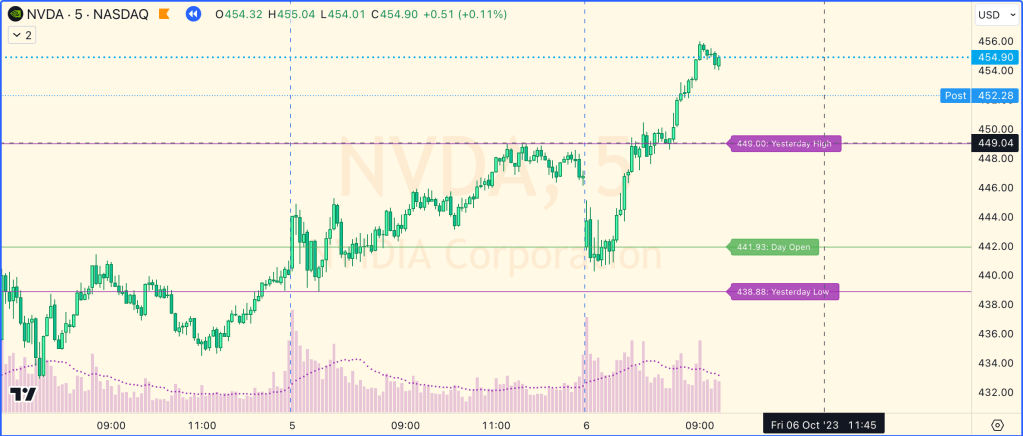
- Key Levels: After spending countless hours each day drawing important levels on the charts for the names I wanted to trade that day, I decided there must be an easier way. This battle-tested indicator draws all of the key levels that happen every day that you might care about (you can decide what to show/hide), like:
- Premarket, after hours, or all of the extended session highs & lows
- Previous hour, day, week & month highs & lows
- Today’s open, highs & lows
- Yesterday’s close
- ATR & 2x ATR highs & lows
- Futures settlement prices for yesterday, last week & last month
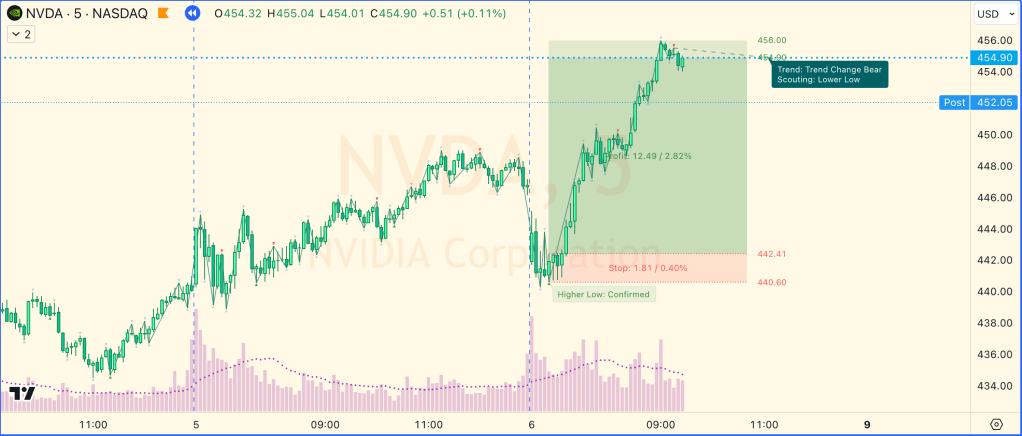
But while these smaller indicators were released, I became obsessed with understanding pivots. I realized that while I understood them conceptually, I really wasn’t paying enough attention to them in my day-to-day trades. And, of course, I was obsessed with understanding how pivots across multiple timeframes were lining up. So, in 2022 I began work on what would become Trend Scout. My goal was to write an indicator that could do what all of the awesome traders I admired do: identify trend and what type of pivot we should be scouting next across multiple timeframes. I was convinced that with this in my warchest, I would be able to see much more clearly where I would run into friction in my trades – being able to spot resistances and supports on timeframes above the one I’m currently viewing.
The indicator took me months to write, and more months to validate. In order to validate it, I would tune into a livestream by ChartingManDan from TCG, and for every ticker he would review, I’d pull up that same chart with Trend Scout on it, and I’d listen to him naturally give his take on what price was likely to do next, and I’d confirm that Trend Scout was telling me the same thing. And eventually, it worked!

When it worked, something else happened: I stopped losing so many trades. In fact, I started winning them. That was when I shared the indicator with Jason from TCG, and together we came up with the plan to release the indicator through TCG. It was just too good to keep to myself!
After the release and changes that came to my trading from Trend Scout, I became much more focused on improving my own understanding of pivots and specifically, where I should be making entries. I began a brand new effort to identify the best entry spots and quantify the risk involved. This indicator was laser focused on where to make entries, and over the months as I tested it, refined it, and traded with it, my inconsistent winning shifted to consistent. At the time of writing, this indicator has never been used by anyone other than me – but it has become the main tool I use to trade every day. Every single one of my entries is based off this indicator showing me what I need to do, and it is the reason I built this website. You can learn all about it here: Trend Tracker.
So that brings you up to speed on where this site comes from and what indicators have been released so far. Where do we go next? I have a handful of other indicators that are built on the same libraries I wrote for Trend Tracker that I’m still refining. I also have an entire web application I’ve built for my own trading, and I know that at some point I will be taking portions of that and exposing them to other traders (probably through this site) for some kind of subscription fee.
But the bottom line is this: I’ve invested an insane amount of time and effort creating these tools, and I want others to benefit from them. I’m not getting rich selling indicators, I’m just trying to earn back some of what I’ve invested, and my hope is that these indicators do for you what they’ve done for me: make you a better trader.
 Improve Your Trading